
Moroccan Wedding Venue: How to Choose the Perfect Place for an Elegant Celebration
By ISMAIL IFAKIR · 22 Jul 2026 · 7 min read
The wedding venue is one of the most important decisions in the planning process. It hosts the guests, decoration, catering, entertainment, photography, and every major part of the celebration.
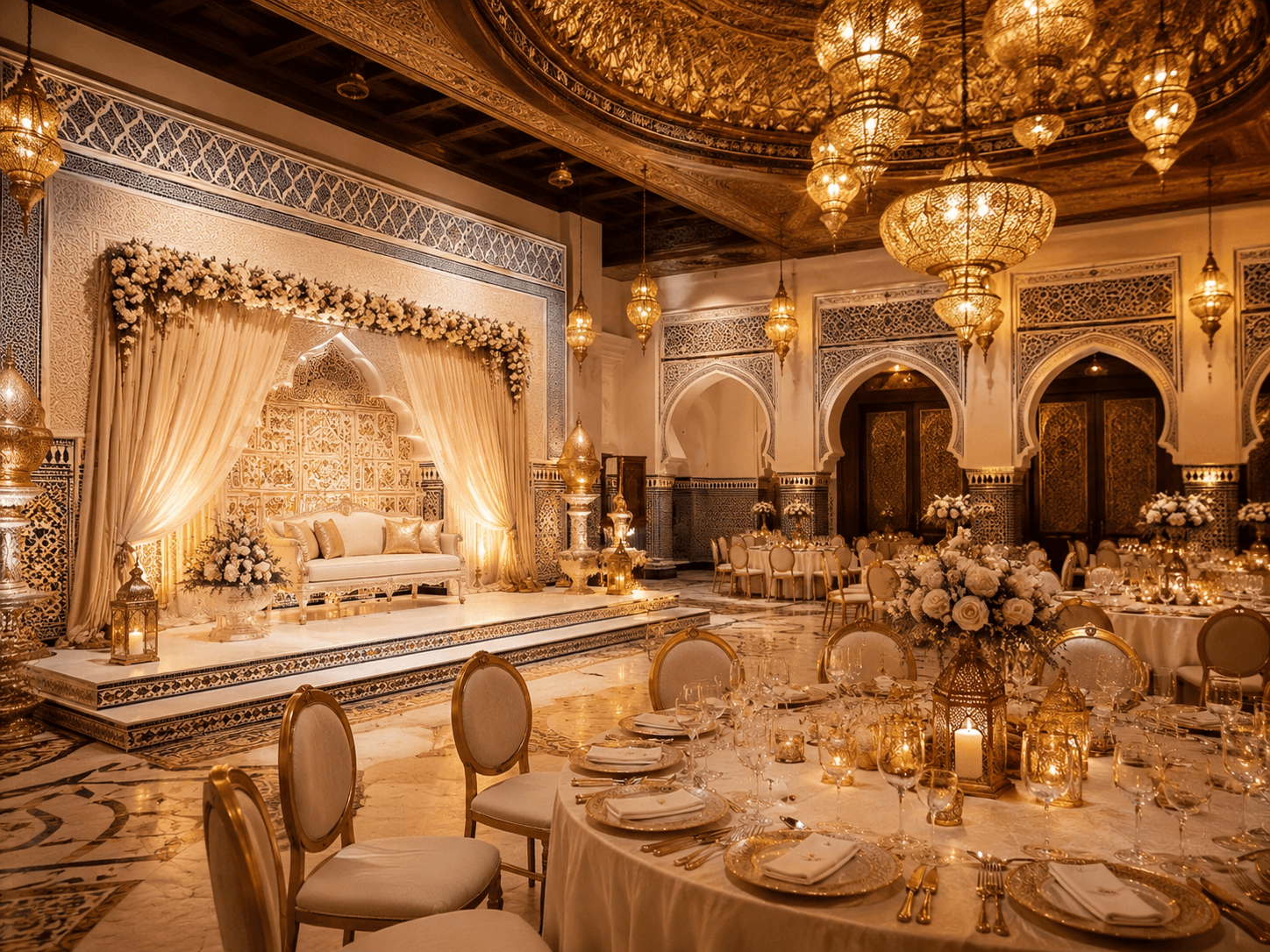
For this reason, couples should not select a venue only because it looks attractive in promotional photographs. They should also evaluate its capacity, location, comfort, facilities, service quality, and total cost.
A beautiful venue may not offer enough space for the amariya or guest movement. Another may advertise an affordable price but charge separately for essential services. Visiting several venues and comparing detailed offers is therefore necessary.
Determine the Guest Count
The estimated guest count helps couples choose the right venue size. A small hall may become crowded and uncomfortable, while an oversized venue can make the event feel empty.
Prepare a preliminary guest list and allow a small margin for later additions. The venue should have enough room for tables, movement, the couple’s stage, musicians, photographers, and service staff.
Do not rely only on the maximum capacity advertised by the venue. This number may not account for the dance area, amariya entrance, or photography space.
Choose the Right Type of Venue
Moroccan weddings may be held in event halls, hotels, riads, reception palaces, gardens, or outdoor spaces.
Event halls often include essential equipment. Hotels can provide convenient accommodation for guests travelling from other cities. Traditional riads offer an intimate and authentic Moroccan atmosphere.
Outdoor venues can be beautiful, but they require a weather backup plan, suitable lighting, sound equipment, and protection from wind or temperature changes.
Consider the Location
The venue should be easy for guests to reach. Consider distance, road conditions, transportation options, and proximity to hotels.
Send the exact digital location to guests before the wedding to reduce delays and confusion.
For distant venues, the couple may arrange transport for some relatives or provide a convenient meeting point.
Parking and Security
Insufficient parking can cause major difficulties at a large wedding.
Ask how many cars the venue can accommodate, whether the parking area is supervised, and whether staff members organise vehicle entry and exit.
When private parking is unavailable, identify safe nearby alternatives and inform guests in advance.
Inspect the Interior Layout
During the visit, observe the venue’s shape, columns, entrances, and movement routes.
There should be appropriate space for the couple’s stage, the amariya entrance, musicians, photographers, and guest circulation.
Large columns or partitions may block the view for some guests and make photography more difficult.
Check the Bride’s Private Room
The bride needs a private and comfortable room for preparation and outfit changes.
The room should be clean, well lit, ventilated, and large enough for the neggafa, makeup artist, hairstylist, and assistants.
A full-length mirror, seating, safe storage, and nearby bathroom facilities are also valuable.
Air Conditioning and Ventilation
Effective air conditioning is essential during summer weddings or large gatherings.
Ask to test the system during the visit instead of relying on verbal confirmation. During colder seasons, heating should also be checked.
Poor ventilation can affect guest comfort, makeup, traditional outfits, and food quality.
Lighting and Photography
Venue lighting has a major impact on the atmosphere and final photographs. Dark rooms or strongly coloured lights can change the appearance of skin tones and clothing.
Visit the venue with the usual event lighting turned on, preferably at the same time of day as the wedding.
The photographer may also recommend additional lighting for the stage, entrance, or photo area.
Sound and Entertainment
The sound system should cover the venue clearly without becoming painfully loud.
Check the speakers, microphones, and connections required by musicians or the DJ.
Ask whether there are limits on music volume or a fixed time when entertainment must end.
Catering Arrangements
Some venues provide their own catering, require a partner caterer, or allow the couple to select an external provider.
When food is included, request the menu, pricing, service details, and a tasting session.
For an external caterer, confirm that the venue provides a suitable kitchen or food-preparation area.
Tables, Chairs, and Linen
Find out whether tables, chairs, tablecloths, and basic serving items are included in the rental.
Inspect the available furniture and confirm its condition, cleanliness, and style. Premium chairs, decorative tablecloths, or special accessories may cost extra.
The selected furniture should be described or photographed in the agreement.
Decoration Rules
Some venues offer fixed decoration or require couples to work with approved decorators.
Ask about rules concerning flowers, candles, hanging installations, lighting, structures, and special effects.
The decorator’s access time and equipment-removal deadline should also be confirmed.
Cleanliness and Restrooms
Inspect the hall, bridal room, kitchen, and restrooms during the visit.
Restroom facilities should be sufficient for the guest count and maintained throughout the celebration.
Ask whether a cleaning team remains present during the event.
Accessibility
The venue should be accessible to elderly guests, people with limited mobility, and families with young children.
Check for ramps, elevators, accessible restrooms, and sufficiently wide pathways.
Tables away from the speakers may be reserved for guests who are sensitive to loud music.
Rental Time and Event Schedule
The contract should state when decorators, caterers, and photographers may enter, when guests arrive, and when the event must end.
Ask about overtime charges and the time allowed for removing decoration and equipment after the wedding.
An advertised rental price may cover only a limited number of hours.
Visit During a Real Setup
When possible, ask to see the venue prepared for an actual wedding or review recent event videos.
This gives a clearer understanding of the available space after tables and decoration are installed.
Any visit should respect the privacy of other clients and their celebrations.
Compare Complete Packages
Compare what each venue includes rather than focusing only on the final amount.
One package may include furniture, catering, cleaning, and decoration, while another covers only the empty hall.
Request a detailed quotation including taxes, deposits, optional services, and additional charges.
A more expensive package may offer better overall value when it includes services the couple would otherwise book separately.
Review the Contract
The contract should include the wedding date, access hours, venue capacity, services, total price, deposit, and payment schedule.
Cancellation, postponement, and refund policies must also be clearly explained.
Important promises should always be recorded in writing.
Questions to Ask Before Booking
Ask about actual capacity, parking, air conditioning, the bridal room, restrooms, cleaning, security, furniture, sound, and lighting.
Confirm which vendors are permitted, when they may access the venue, and what restrictions apply to decoration or music.
Clear written answers significantly reduce the risk of misunderstandings.
Mistakes to Avoid
Do not book a venue before estimating the guest count, and avoid selecting an oversized hall only because it looks prestigious.
Never pay a large deposit without visiting the venue and reading the agreement.
Couples should also avoid assuming that all furniture, lighting, and decoration shown in promotional images are included.
Choosing a Venue Within the Budget
The venue budget should include possible catering, decoration, furniture, sound, cleaning, and overtime charges.
Weekday or off-season dates may offer better prices.
Choosing a venue that matches the actual guest count is usually more effective than paying for unused space.
Why Does the Right Venue Matter?
The right venue supports smooth organisation, makes guests comfortable, and allows every vendor to work effectively.
When the space, facilities, and services match the wedding programme, the couple can focus on enjoying the celebration.
Through Afrahi, couples can discover Moroccan wedding venues, review their photographs, compare services, and select a location that matches their guest count, wedding style, and budget.